Why this project exists
Status: project narrative, 2026-10-11. A five-minute read; every claim links to its evidence.
The gap: applications think in content, terminals think in rows
AI agents generate, revise, and finalize content throughout an ongoing session. Applications manage that content as logical units with identity and lifecycle, while the terminal protocol expresses character output and screen operations. The gap is between the application’s content model and what it can communicate to the terminal — not between two redraw strategies.
The concrete consequence: rows already committed to terminal-owned scrollback have no application-addressable identity. An application that must revise earlier output cannot name it, so it can only redraw — and every available redraw strategy disturbs the reader.
The available paths
Redraw in place. Differential redraw rewrites only changed lines; it
cannot reach anonymous rows already in scrollback, so it cannot express
revision of historical content at all. When streamed output reflows above
the viewport, correctness forces a full redraw: clear and replay
(ESC[3J), which reaches historical rows at the cost of the reader’s
position and selection. A Pi user documented that mechanism and the
protocol-level constraint behind it in
pi issue #7304; Kimi
Code’s attempt to contain the damage — anchoring differential patches to
buffer row indices while content shifted underneath — ended in a full
revert with the symptom re-accepted
(PR #1367).
Application-owned viewport keeps a private transcript and reimplements scrolling, selection, search, and copy inside the application. It delivers good rewrap and copy fidelity, but feeling native across terminal emulators, operating systems, input modalities, multiplexers, and fonts is a combinatorial tail. OpenAI’s Codex retired its TUI2 experiment after deleting 82,802 lines (PR #9640). Pi’s alternate-screen renderer, intended to become the default, is still resolving full-transcript repaint costs (issue #9549).
The configuration none of these provides: terminal-owned history that stays correct when offscreen content changes, with the reader’s position preserved.
The third path
Give content identity at the protocol layer. The application decides what the content is and when it changes; the terminal decides how it looks, where it sits, and keeps the user’s reading position; a small protocol carries semantic changes between them — append, update, extend, replace a suffix, seal. The terminal never has to clear and replay; the application never has to reimplement scrolling, selection, search, or copy. The formal model is RFC 0001.
What exists today
Three milestones through 2026-10-03. The latest: Pi 0.87.1’s stock interactive UI — its unmodified editor, footer, and status — running while the transcript above is owned by protocol Blocks, verified by four automated browser scenarios through a real terminal path: a full turn with editor input during streaming, cancellation and a further turn, a resize round trip, and unsupported-terminal fallback (Pi stock-UI trial).
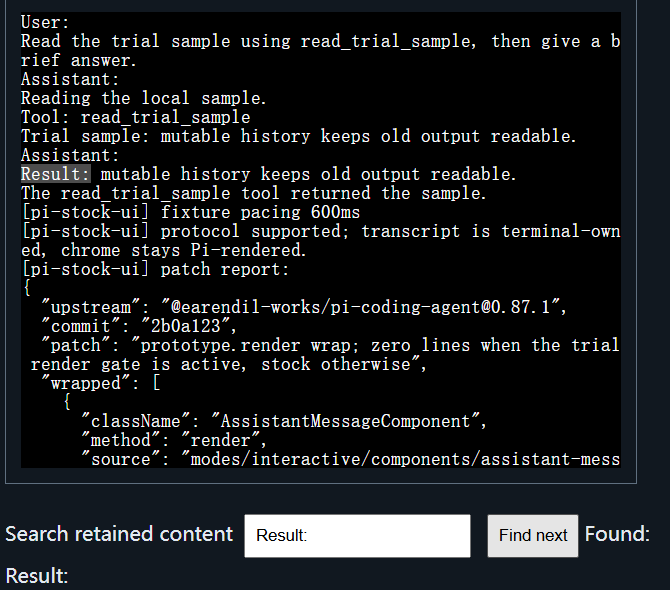
The repository holds 300+ Node tests, dated checkpoints, and bounded claims throughout — including recorded failures, such as the two-writer conflict that motivated the terminal host’s region ownership.
Honest status
This is a research prototype, not a standard. Content is plain text only; the supporting terminal is one experimental host; the evidence is Windows-only so far; live-model runs exist for the SDK frontend but not yet for the stock-UI path. Two constraints shape what happens next: the cold-start loop and one maintainer’s bandwidth (current constraints).
Who might care, and what would help most
People who use agent TUIs every day. This project exists for their reading experience: keeping your place, your selection, and your history while output streams. If that is you, this evidence is yours to cite when asking your terminal or agent of choice for a fix — user demand is what moves vendors.
Terminal emulator developers and TUI framework authors who have hit the same wall. The single most useful contribution is a second terminal-side implementation, independent of this project’s host code (adoption path).
Agent-application teams choosing a rendering strategy. The three documented attempts above are the map of what has already been tried.
All evidence and design documents are public, and the protocol drafts describe the semantics in full.